ResQPOD™
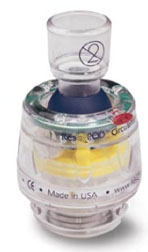
The ResQPODT is a circulator enhancer which improves blood flow in patients with cardiac arrest. It's been used with ACD in the standard CPR procedures. It's not recommended for pregnant women and patients younger than 18 years old.Excessive ventilation may reduce the ResQPODT efficiency.
Mechanism of Action
How does the ResQPOD Circulatory Enhancer improve CPR?
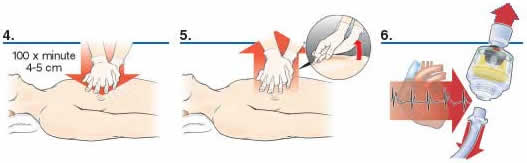
The ResQPOD works by enhancing the efficiency of CPR. It utilizes the interdependence of the body's respiratory and circulatory systems to create a vacuum within the chest during the recoil phase of CPR, after each chest compression. The ResQPOD prevents the influx of respiratory gases into the chest during the relaxation or decompression phase, which lowers the intrathoracic pressure and draws greater venous blood back to the heart. Improved blood return to the heart (preload) results in improved blood flow out of the heart (cardiac output) during the subsequent compression.
What are the intrathoracic pressure levels found in a healthy, spontaneously breathing person compared to a cardiac arrest patient receiving CPR alone and to a patient receiving CPR in conjunction with the ResQPOD Circulatory Enhancer?
Average intrathoracic pressure:
- in a healthy, spontaneously breathing person, measured in the trachea during inspiration, is approximately -2 mmHg;
- an intubated patient in cardiac arrest who is receiving CPR alone, the intrathoracic pressure is approximately -2 mmHg;
- in a cardiac arrest patient who is receiving ACD CPR with the ResQPOD in place, the intrathoracic pressure is approximately -10 mmHg.
The greater the negative intrathoracic pressure, the more blood that returns to the heart. However, it should be noted that excessive negative pressure can be detrimental. The ResQPOD has been specifically designed to safely optimize the degree of negative pressure for maximum blood flow return to the heart.
Is the ResQPOD Circulatory Enhancer effective with standard and active compression decompression (ACD) CPR?
The combination of animal and human studies have shown statistically significant levels of improvement in survival from cardiac arrest and normal neurological function when the ResQPOD is used in conjunction with standard or ACD CPR.
Does the ResQPOD Circulatory Enhancer interfere with the patient's ability to exhale?
No, the ResQPOD provides no resistance to patient exhalation. Expired air leaves the patient through the ventilation connection port.
Does the ResQPOD Circulatory Enhancer limit the rescuer's ability to ventilate the patient?
No, the patient may be freely ventilated, without resistance, at whatever compression to ventilation ratio and tidal volume the situation dictates.
Is hyperventilation helpful during CPR?
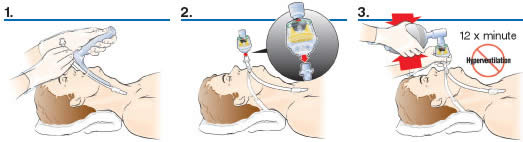
The natural tendency when performing CPR is to ventilate the patient frequently. Contrary to common practice, hyperventilation is very detrimental during CPR. Each extra breath interferes with the development of negative intrathoracic pressure created during the chest wall recoil or decompression phase. Thus, hyperventilation, that is, ventilation more often than 12 times/minute, markedly reduces the efficiency of all methods of CPR, with or without the ResQPOD. Hyperventilation during use of the ResQPOD, will prevent the intrathoracic pressure levels from going below zero, resulting in no significant venous return to the chest. This is a fundamental point that must be heavily emphasized while training rescuers on how to do any method of CPR and the use of the ResQPOD.
In alignment with the European Resuscitation Council (ERC) and American Heart Association (AHA) Guidelines, we strongly recommend 15:2 compression: ventilation ratio in patients with an unprotected airway and no more than 12 ventilations per minute in a patient with a protected airway.
Will the ResQPOD Circulatory Enhancer hinder patients who begin to breathe spontaneously?
Yes, patients who begin to breathe on their own will have to overcome the -15 cmH 2 0 cracking pressure before ambient air will be allowed to enter the valve. It is for this reason that the ResQPOD must be removed immediately from the respiratory circuit upon return of a pulse or when CPR is no longer needed.
What force (in kPa and cmH 2 0) must the patient generate to permit spontaneous breathing through the ResQPOD Circulatory Enhancer?
The patient's respiratory efforts must generate a pressure of -15 cmH 2 0 or 1.47 kPa for the ResQPOD to allow for ambient airflow.
What effect does altitude have on ResQPOD Circulatory Enhancer function; i.e. can it be used in aero medical or submarine environments?
None. Altitude does not effect the performance of the ResQPOD.
What effect will breath stacking (delivering a series of breaths without compressions in between) have on the ResQPOD's function?
Breath stacking will delay the effect of the ResQPOD, as the pressure within the chest is higher after breath stacking. It is for that reason that the ERC and AHA guidelines recommend a 15:2 compression to ventilation ratio. In intubated patients, we recommend an 8:1 compression to ventilation ratio (equivalent to 12 ventilations/minute at a compression rate of 100/min), which is consistent with the ERC and AHA Guidelines.
Silicone valves are known to stick when they become warm and wet from respiration - especially diaphragm valves. Does the ResQPOD Circulatory Enhancer remain functional in extreme temperatures and humidity?
Yes, the ResQPOD has been tested under extreme temperature and humidity conditions and remains functional. |