( A Pocket Guide to Cold Water Survival-US Department of Transportation-United States Coast Guard-Kindly submitted by Captain M. F. Cowan ).

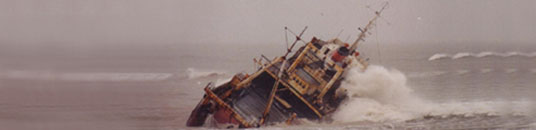
If you are involved in a ship casualty and are forced to abandon, your survival procedure should be preplanned, thereby increasing your chances for a successful rescue. Records show that ship sinking , even in the worst cases, usually requires at least 15 to 30 minutes for the vessel to fully submerge. This affords valuable time for preparation. Here are some sound pointers for you to remember in a situation of this type:

1. Put on as much warm clothing as possible, making sure to cover head, neck, hands and feet.

2. If an immersion ( exposure ) suit is available put it on over the warm clothing.

3. If the immersion ( exposure ) suit does not have inherent flotation, put on a lifejacket and be sure to secure it correctly.

4. All persons who know that they are likely to be affected by seasickness should, before or immediately after boarding the survival craft, take some recommended preventive tablets or medicine in a dose recommended by the manufacturer. The incapacitation caused by seasickness interferes with your survival chances; the vomiting removes precious body fluid while seasickness in general makes you more prone to hypothermia.

5. Avoid entering the water if possible. Board davit-launched survival craft on the embarkation deck. If davit-launched survival craft are not available, use overside ladders, or if necessary lower yourself by means of a rope or fire hose.

6. Unless it is unavoidable do not jump from higher than 5 meters into the water. Try to minimize the shock of sudden cold immersion. Rather than jumping into the cold water, try to lower yourself gradually. A sudden plunge into the cold water can cause rapid death or an uncontrollable rise in breathing rate may result in an intake of water into the lungs. On occasions it may be necessary to jump into the water; if so, you should keep your elbow at your sides, cover your nose and mouth with one hand while holding the wrist or elbow firmly with the other hand. One should not jump into the water astern of the liferaft lest there is any remaining headway on the ship.


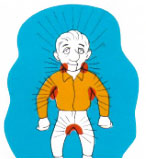
High heat loss areas

7. Once in the water, whether accidentally or by ship abandonment, orientate yourself and try to locate the ship, lifeboats, liferafts, other survivors or other floating objects. If you were unable to prepare yourself before entering the water, button up clothing now. In cold water you may experience violent shivering and great pain. These are natural body reflexes that are not dangerous. You do, however need to take action as quickly as possible before you lose full use of your hands; button up clothing, turn on signal lights, locate whistle, etc.

8. While afloat in the water, do not attempt to swim unless it is to reach a nearby craft, a fellow survivor, or a floating object on which you can lean or climb. Unnecessary swimming will "pump" out any warm water between your body and the layers of clothing, thereby increasing the rate of the body-heat loss. In addition, unnecessary movements of your arms and legs send warm blood from the inner core to the outer layer of the body. This results in a very rapid heat loss. Hence it is most important to remain as still as possible in the water, however painful it may be. Remember pain will not kill you, but heat loss will !

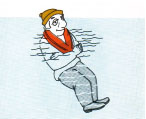
9. The body position you assume in the water is also very important in conserving heat. Float as still as possible with your legs together, elbows close to your side and arms folded across the front of your lifejacket. This position minimizes the exposure of the body surface to the cold water. Try to Keep your head and neck out of the water. Another heat conserving position is to Huddle closely to one or more persons afloat, making as much body contact as possible. You must be wearing a lifevest to be able to hold these positions in the water.


10. Try to board a lifeboat, raft or other floating platform or object as soon as possible in order to shorten your immersion time. It is always better to get out of the water than it is to stay in. Remember, you lose body heat many times faster in water than in air. Since the Effectiveness of your insulation is seriously reduced by water soaking, you must now try to shield yourself from wind to avoid a wind-chill effect ( convective cooling ). If you manage to climb aboard a lifeboat, shielding can be accomplished with the aid of a canvas cover or tarpaulin, or an unused garment. Huddling close to the other occupants of the lifeboat or raft will also conserve body heat.

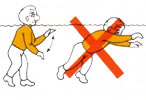
11. Do not use "drownproofing" in cold water. "Drownproofing" is a technique whereby you relax in the water and allow your head to submerge between breaths. It is an energy saving procedure to use in warm water when you are not wearing a life vest. However, the head and neck are high heat loss areas and must be kept above the water. That is why it is even more important to wear a lifevest in cold water. If you are not wearing a vest, tread the water only as much as necessary to keep your head out of the water.

. . Drownproofing
12. Keep a positive attitude about your survival and rescue. This will improve your chance of extending your survival time until rescue comes. Your will to live does make a difference !