Forced-air warming system
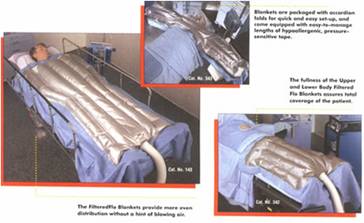
Warm air is blown into warming covers and exits through holes on the patient side of the covers, providing convective heat transfer of 60-70 W over the entire body. As they are relatively compact, could also be adapted for transportable use in motor vehicles.
Forced-air warming has the possible advantage of minimizing the post-cooling drop in core temperature , decreasing shivering and its associated metabolic stress, and transferring enough heat to compensate for the consequent decrease in heat production and maintain an adequate rate of rewarming.
Most hospitals in Germany , Austria and Switzerland use forced warm air for rewarming in situations where spontaneous circulation exists. No side effects were described even in severe hypothermia.
Cincinnati Sub Zero forced warm air blankets
Central Medical Supplies Ltd, CMS House, Basford Lane ,
Leek, Staffordshire , UK . ST13 7DT.
Tel: 01538 399541 Fax: 01538 399572 E-mail: sales@centralmedical.co.uk
www.centralmedical.co.uk |